




Some video games are enjoyable for a few months and then quietly disappear from your memory. Others leave such a massive mark on gaming that you can still feel their influence years later. Half-Life is very much in the second category.
Originally released for PC in 1998, Half-Life completely changed expectations for what a first-person shooter could be. Instead of simply throwing you into a series of disconnected shooting galleries, it creates a proper journey where the story, environments and gameplay all work together.
You play as Gordon Freeman, a theoretical physicist whose ordinary day at the Black Mesa Research Facility goes spectacularly wrong. A scientific experiment causes a catastrophic incident, opening a portal to another dimension and unleashing a load of rather unpleasant aliens.
And that’s when things properly kick off.
What makes Half-Life so memorable is the way it tells its story without constantly stopping the game. There aren’t endless cutscenes interrupting your progress. Instead, important events happen around you while you’re still in control. Characters talk to you, scientists panic, security guards try to survive and the environment itself gradually reveals what’s happened.
It sounds fairly standard nowadays, but at the time it was a massive deal.
The atmosphere is another major strength. Black Mesa feels like a real facility rather than just a collection of levels designed to give you things to shoot. You’ll move through laboratories, underground areas, military installations and plenty of places where everything has gone horribly wrong.
There’s a constant feeling that you’re trying to escape a disaster rather than simply completing another level.
The combat is surprisingly varied as well. You start with relatively basic weapons before gradually building up a much more impressive arsenal. There’s plenty of shooting, but Half-Life also mixes things up with puzzles, platforming, exploration and sections where you’re simply trying to work out where on earth you’re supposed to go next.
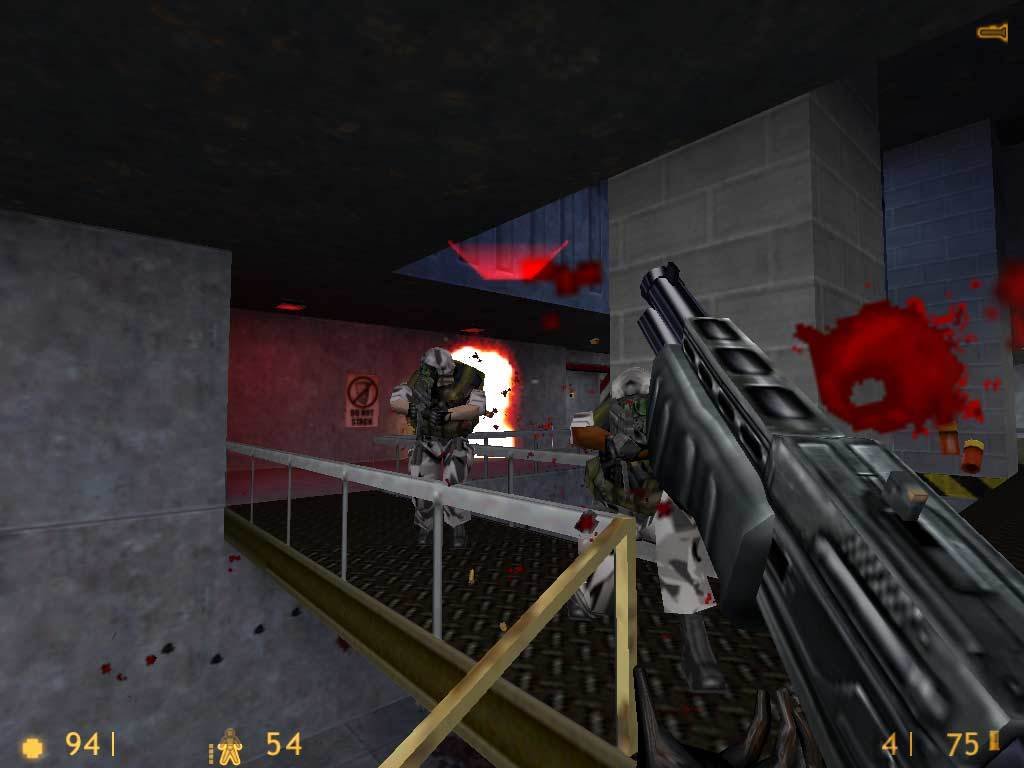
And then there’s the AI. Some of the enemies can still put up a decent fight, while the friendly NPCs add plenty of personality to the journey. The marines in particular can make certain encounters properly tense, as they don’t just stand around waiting for you to shoot them.
One of my favourite things about Half-Life is how often it makes you feel like you’re part of the situation. You’re not constantly being told that something terrible has happened — you’re walking through the aftermath and figuring it out yourself.
The pacing is generally excellent too. The game knows when to throw you into a firefight and when to slow things down. You’ll have intense battles followed by quieter exploration, giving the action more impact when it eventually kicks off again.
Of course, going back to Half-Life today does come with a few caveats. The graphics obviously show their age, and some of the movement and level design can feel a bit dated compared with modern FPS games. There are also moments where figuring out exactly what the game wants you to do can be more frustrating than clever.
But once you get past that, it’s remarkably easy to see why this game became such a big deal.
Half-Life isn’t just historically important — it’s still genuinely fun to play. Its approach to storytelling, atmosphere and level design influenced countless shooters that came afterwards, and you can spot its ideas all over modern gaming.
If you’ve somehow never played it, it’s well worth giving it a go. And if you played it years ago, revisiting Black Mesa can be a surprisingly brilliant trip down memory lane.
Final verdict: 9.5/10
Iamge via: Cameron Stapleton